Albert Einstein said, “Once you stop learning, you start dying.” That’s a pretty serious comment. But it makes sense when you think about it. You become stagnate and stale when you refuse to adapt and grow. This is especially true for authors.
We develop and refine our style with every project we do. My first book and how I wrote it look nothing like what I’m doing now. We need to continue to learn and grow as authors to improve our craft and keep readers interested.
Read craft books.
There are thousands of craft books out there, and more are coming out every day. Don’t feel like you have to stumble around in the dark looking for a light switch. Learn from those who have come before you. A few of my favorites are “Anatomy of Prose” by Sasha Black, “Shut up and Write the Book” by Jenna Morecci and “Show, Don’t Tell Guidebook for Writers” by Ashley Earley. They all have been enormously helpful to me in my journey and development as an author.
Take a course.
This one is actually on my to-do list. One of the best things about our technology-enhanced world is the ability to attend classes and seminars from anywhere. Online learning platforms like Masterclass and Skillshare offer lessons on almost anything from the individuals who do it best. You can find the ones that best suit your needs and go at your own pace.
Join a writing club
Feedback is a critical part of learning. If you never receive feedback on your work, you can’t learn how to make it better. Writing clubs and groups where people share their writing and give feedback are invaluable resources. I know sharing an unfinished, unedited work with people is scary. Trust me. But it is so worth it. Learning from your peers before you spend hours on edits can save you valuable time, energy, and sanity.
Growing your craft is an essential part of being an author. Explore the options around you. Learn from other writers. Share your work with a trusted group. However you choose to do it, keep learning and growing. There is always more to know.
My second novel came out on August 29, and let me tell you – getting that baby up and out felt like a massive weight off my shoulders. The response has been overwhelmingly positive, which is great. Even better than the sales and reviews are the lessons I’ve learned during the process.
1. Skinny Draft
While writing this novel, I discovered that I am a far better editor than a drafter. I was introduced to the “skinny draft” idea about halfway through my first draft. The purpose is to write a draft of your story without worrying about small details that often stall the writing process. Focusing on getting the story right first helped me see more progress faster than trying to get everything in the first time around.
2. Progress Report.
I have to see progress. If I don’t feel like I’m getting anywhere, I get discouraged and want to quit. A lot of writers use their word count to track progress. This doesn’t work for me. It tells me nothing about where I am in the story or how far I have left to go. Switching from word counts to “signposts” for my progress shows me where I am and makes me want to keep going.
3. Change Up.
Changing a deadline is okay. Yes, there are going to be some that are set in stone. Your editor must have your manuscript by a specific date to complete their work. That’s fine. But as an indie author, I am the one who decides when to start contacting them. The self-imposed deadlines I make to keep me on track are flexible. Life happens, and sometimes you have to slow down. I nearly burned myself out trying to meet some deadlines I set on this one. It’s better to move everything back than burn the candle at both ends and in the middle to meet a self-imposed deadline.
4. Process Evolution.
The way you write evolves. I’ve said it before, and I’ll say it again. There is a reason it is called a writing process. As you learn more and develop your skills, how you approach a project changes. And that’s okay. My first novel went chapter by chapter, trying to make each one perfect before moving on to the next. It made everything longer and harder for me. Starting small and expanding is freeing for me. I’m sure my current process will change again. And that’s okay, too. We all develop and change, so our writing should, too.
What I’ve learned through bringing Coming Home into the world is invaluable. I could spend days discussing them, but we only have so much time. For my writers out there, how has your process changed? Leave me a comment below to keep the conversation going.
Genre is a little word with big impact. Knowing the right way to categorize your story gives you insight into what it takes to make readers choose it over others on the shelf.
There are dozens of genres out there. Each one has its own standards and guidelines that set it apart. The most popular fiction genres are:
Fantasy
Sci-fi
Mystery
Thriller
Romance
Western
Dystopian
Contemporary
We can break each one down into countless subgenres. Check the link below for a more detailed list.
Readers have set expectations for each genre’s length, tropes, and story structure.
The length of a novel can be a deterrent for readers looking for a specific genre. A romance novel, for example, is usually 50 – 75,000 words. An epic fantasy, on the other hand, can easily be 100,000+. Writing a romance novel the length of Lord of the Rings can make readers raise their eyebrows or even pass on the book. While there is no hard and fast word count rule, keeping your story within the standard helps ensure your audience doesn’t turn away from it without at least cracking the spine.
Does anyone else remember the Twilight craze? Please say yes. I don’t want to feel old. This set off a massive trend of vampire and werewolf romance novels in all shapes and sizes. Knowing what is popular in your genre is essential to ensure it sells. If you are writing a shifter romance, but everyone is reading Christmas stories, it may sell poorly. That doesn’t mean you can’t write it. You may want to wait to hit the publish button or submit it to an agent at a different time.
Every genre has elements that define it. Romance novels have to have a happily-ever-after (HEA). If it does not have a HEA, it’s not a romance. End of story. Romeo and Juliet is a tragedy because they (SPOILERS) die at the end. It is a romantic story, but it is not a romance because of how it ends. If I didn’t know that was how it ended going in and snatched it off of a romance shelf at the store, I would be ready to go on the warpath at the end.
Genre is making a promise to your reader about what they can expect from your story.
Knowing your genre and understanding how it works will go a long way in crafting a story your readers will love. It identifies your audience and gives you a roadmap to follow along the way. Do your research, and you will make your life that much easier.
I’ve said it before, and I’ll say it again. Writing is hard. This is readily accepted, but what many of us never talk about is that it never really gets any easier. We expect more of ourselves as we gain experience and learn more about our craft. This can leave the door open for impostor syndrome to wreak havoc on our writing lives.
This is something I’ve been dealing with lately. My edits seemed to take my WIP farther away from where I wanted it to be. Every time I sat down to write, all I could think about was how god awful it was and how inept I was at fixing it. I was seconds away from setting it all on fire and walking away. That’s when I realized I needed some perspective.
On nearly every project, every writer will reach a point where they want to rip their work to shreds and call it a day. It’s the nature of the beast. So what do we do when we get like this? How can we possibly find a way to pick back up and move forward when we are convinced our work is a steaming pile of cow dung?
I reached out to some of my friends in the writing community for advice. I asked my personal circle and left messages on several writer community pages I am a part of. Everyone came back with the same basic answers. Space. Recharge. Critique.
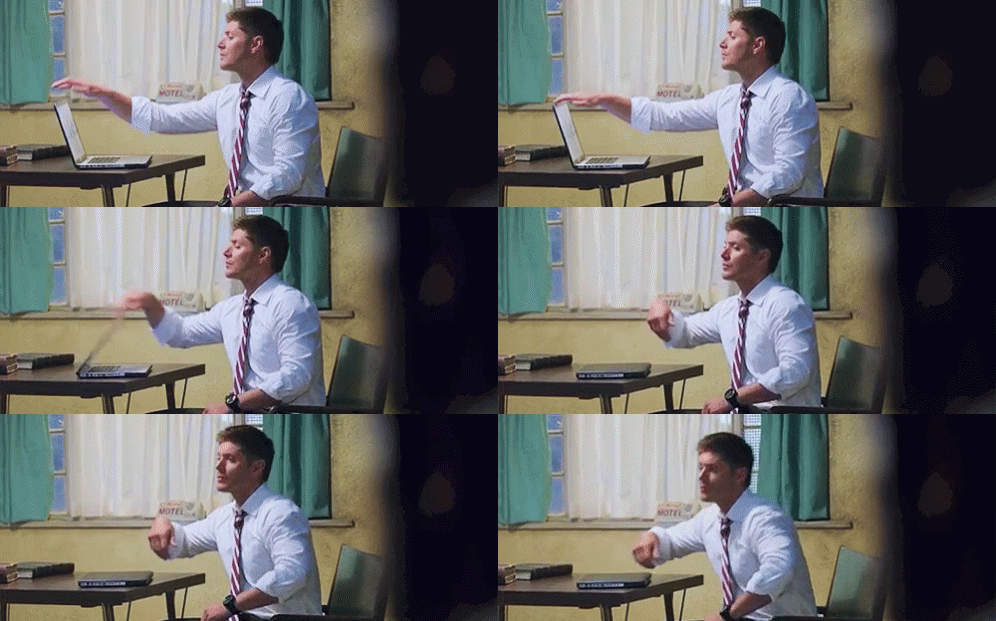
I can’t resist a Supernatural reference.
Stepping away from a project is challenging. At least for me. I am one of those 100% completion kind of people. I will spend hours aimlessly exploring one tiny section in a video game. I make sure I find all the hidden items and mine as much XP from it as possible from the game. If I’m going to do something, I’m going to do it tenfold. There is no halfway. However, there are times when you just need to back away. Set the project aside for a while. And I’m not talking for a few hours. I’m talking days. Months even. It’s so easy for us to get wrapped up in the cycles of fruitless effort that we may as well just sit and bang our heads on our keyboards for as much good as it’s doing us. Getting some space from your work allows you to return to it with fresh eyes and see it in a new light.
This is how I picture my brain.
I know I have referenced the spoon theory in previous posts, but I’m not sure if I’ve told you all about the “hamster wheel.” I often refer to my brain’s ability to function like a hamster wheel. When things are clicking, the hamster is running for all he’s worth without a care in the world. Those are good days. They are productive and leave me feeling accomplished. Then there are the days when I’ve exhausted the hamster. He’s just laying on the wheel, one little leg hanging off the side, gently rocking it back and forth just enough to keep essential bodily functions operational. Anything beyond that is simply out of the question. Don’t exhaust your hamster. Give it a rest and do something else to recharge your brain. Better yet. Try to do something that has nothing to do with books or writing. Watch a movie. SLEEP. Drink a cup of tea on the porch while watching squirrels chase each other. Whatever it looks like, let your hamster rest so he can get back on the wheel and keep running.
Me starting the editing process.
As authors, we spend a lot of time with our stories. It takes an average of three to five years to finish a novel. That’s a long time. Because we spend so much time in these worlds, our perspective of them can be a bit skewed. We know things about our characters and settings that never see the page. It may be useless drabble. Or it could be a crucial piece of their character that informs the overall plot. Regardless of what it is, we are too close to the work and need an outsider’s perspective. Finding a small group of fellow writers to read your work with a critical eye and provide feedback is invaluable. It lets you see where your story stands from a reader’s perspective while having a writer’s keen eye. They can help you brainstorm solutions to problems they find and pick you up along the way.
Regardless of the route you take, give yourself some grace. What you are trying to accomplish is not an easy task. It takes time. So give yourself some space from your work. Recharge your battery, and get some fresh perspective. It just might save your sanity and keep your WIP alive.




 Erin McKnight