Posted in resources, writer life, writing advice

Community Connections

Everybody needs people. Introverts, hold your horses. I know what you’re thinking. “No, I don’t. Introverts don’t need people.” I beg to differ. We all need a community that can rally around us and support us in reaching our goals. This is especially true for writers.

While writing is a solo activity, writers can’t succeed in a vacuum. We need people around us to support us in our journey. I don’t care if it is your first book or your thousandth. Having a group of fellow writers that can talk you off a ledge or help you work through the story issues causing chaos in your brain will get you a lot farther, a lot faster than trying to slog through it all on your own.

Writing communities are also a great place to find beta readers and street team members. We need people we can rely on to help us out. I can’t tell you the number of times someone signed up to be a beta reader or help promote my book and didn’t follow through, but do you know who has always followed through for me? Other writers.

We are all in the same boat. We understand how important these things are and will help each other reach our goals.

Fellow authors are fantastic resources. By networking with other writers, you can learn about the latest trends in your genre, best marketing practices, and much more. 

The hardest part about a writing community is finding one, and even that isn’t difficult. Facebook has a wide variety of reader and writer groups. Doing a quick search will yield more results than you can shake a stick at. Look around and see if you find one that sounds right. And remember, just because you join doesn’t mean you have to stay there. Finding the right writing group is like finding the perfect pair of pants. Sometimes you have to live in them for a while before you find the right fit.

NaNoWriMo is another excellent way to find fellow writers. While the event may only be one month out of the year, several groups continue to interact all year long. They even offer home region groups that can meet in person if you do better with face-to-face interaction.

Speaking of face-to-face, don’t forget to check with your local library. See if yours has a writing group. Or even a book club. Telling an avid reader you are working on a novel and would like their feedback is like dangling a seal in front of a Great White. They will jump at the chance to be a part of the process. 

There’s nothing quite like a kick-ass writing community to help you achieve your goals. They offer insight and feedback. They encourage you when you’re down, and they will party like there is no tomorrow when you get it right. Step out on a limb and connect with a community of your own. It is well worth it.
Posted in writing advice

The Power of the Skinny Draft

 There are a thousand ways to draft a novel. They can be broken down by scene, chapter, character. The list goes on. They can be told in order or have scenes shuffled around like a deck of cards. A method I’ve learned about more recently is the skinny draft. A skinny draft is a complete draft that focuses on placing the plot elements in the correct order with minimum description. It can contain dialog and locations, but describing the setting and emotion is left at a bare minimum.

I know what you’re about to say. Erin, aren’t we supposed to use description and emotion in our stories? Of course we are. Those are the things that bring a story to life, but that doesn’t mean you have to have every possible detail in your first draft.

A skinny draft is designed to get you to a completed draft as quickly as possible. A lot of writers struggle with feeling discouraged because of the time it takes to complete their first draft. This method shortens that time and gives you a little shot of dopamine to help you stay motivated.

Another benefit of the skinny draft is the ability to learn more about your characters

and plot without having to sort through a massive word count. This can be doubly important for discovery writers or pantsers. Answering the “what happens next?” question can eliminate the need for as many drafts because the plot is solidified much faster.

While skinny drafts can keep you from writing a bunch of words that end up in the trash can, it is not a method that works for everyone.

I used the skinny draft method on my current WIP. It helped me identify issues a lot quicker, but I found that the overall process is going a lot slower for me.

I am an over-writer by nature. (Remember my friend’s wordy bitch comment?) My style tends to include a lot of fluff that must be cut later, but that is also how I learn more about my characters. It is much easier for me to take stuff out than put it in. Without those details early on, I don’t feel as connected to my characters. This makes it harder for me to keep working on it because I’m not as invested in their journey.

 Regardless of your method, ensuring you get to the end is the most important part.

 How do you do your first draft? Have you tried using a skinny draft? What method works best for you?

Posted in resources, writer life, writing advice

Lessons Learned: Book Signing Events

One of the many things I never thought I’d have to do when I decided to become an author was public speaking. My mentality was that book signings are only for big-name authors. Nobody is going to want a signed copy from a debut indy author. They only want best-sellers. Boy, was I wrong.

I recently did a book signing at a public library near where I grew up. I loved every minute of it, but there were a few things I could have been better prepared for. Here are a few takeaways I have after being a part of my first author event.

BRING MORE BOOKS THAN YOU THINK YOU NEED
People love signed books. I thought that since this event was in such a small town, I wouldn’t need very many books. The library was packed to the gills. I could have sold twice as many books if I’d had them. Next time, I’ll double the number of books I take. Turning people away because you are out of books is a terrible feeling.

BE READY FOR SOME NON-BOOK/WRITING QUESTIONS
I’m a prepper. I spent time reviewing interview transcripts from authors I follow to try and see what kind of questions I would have to answer. I wasn’t prepared for the questions about me and my life. People find it fascinating that you were able to write a book and want to know about you. Not just your work.

HAVE SWAG AND TELL PEOPLE ABOUT IT
Everybody loves free stuff. Having a few free giveaways on your table is a must. This will help people find your book later if you run out, and it helps promote your brand. Just be sure you tell people you have it before they start coming up. The transition from Q&A to signing was so fast that I forgot to tell people I had bookmarks and pens they could have for free until they got up to the table. It does no good to have swag if nobody knows to take it.

DON’T FORGET TO TELL PEOPLE WHAT YOUR BOOK IS ABOUT
I feel like this one should have been obvious, but I totally forgot it. I introduced myself and gave a bit of my background, but it took somebody asking me what my book was about for me to give the synopsis. Embarrassing, I know. Maybe lead with that one next time.

Author events are a fun way to get your book in front of readers and interact with them. While no two events are the same, it’s always good to cover the basics. Do some prep work ahead of time to be prepared when that inevitable curveball arrives.

Posted in Uncategorized, writing advice

Walk Away: Getting Space From Your Work

I’ve said it before, and I’ll say it again. Writing is hard. This is readily accepted, but what many of us never talk about is that it never really gets any easier. We expect more of ourselves as we gain experience and learn more about our craft. This can leave the door open for impostor syndrome to wreak havoc on our writing lives.

This is something I’ve been dealing with lately. My edits seemed to take my WIP farther away from where I wanted it to be. Every time I sat down to write, all I could think about was how god awful it was and how inept I was at fixing it. I was seconds away from setting it all on fire and walking away. That’s when I realized I needed some perspective.

On nearly every project, every writer will reach a point where they want to rip their work to shreds and call it a day. It’s the nature of the beast. So what do we do when we get like this? How can we possibly find a way to pick back up and move forward when we are convinced our work is a steaming pile of cow dung? 

I reached out to some of my friends in the writing community for advice. I asked my personal circle and left messages on several writer community pages I am a part of. Everyone came back with the same basic answers. Space. Recharge. Critique.

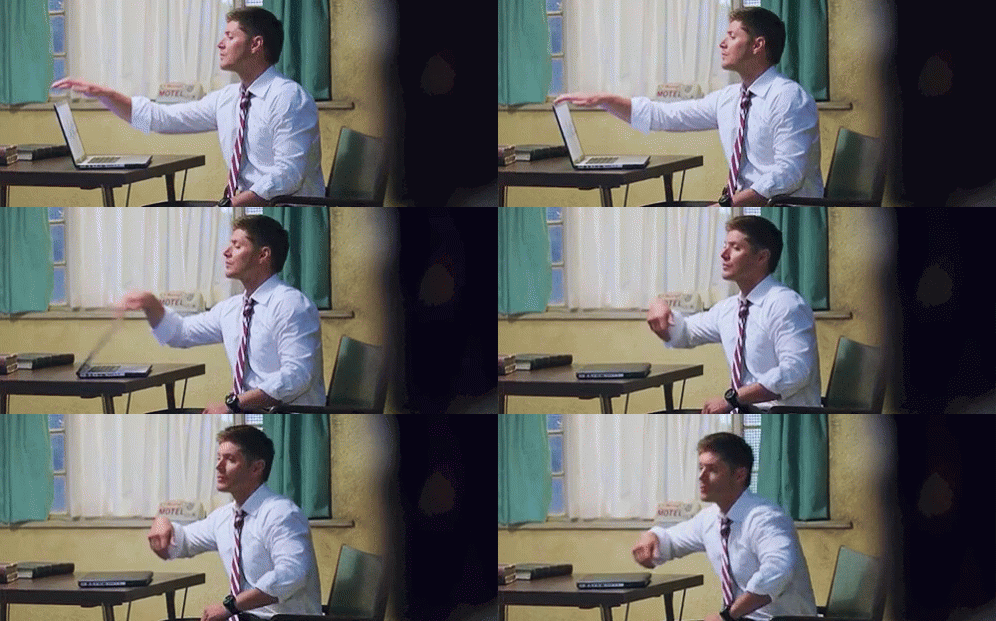
I can’t resist a Supernatural reference.

Stepping away from a project is challenging. At least for me. I am one of those 100% completion kind of people. I will spend hours aimlessly exploring one tiny section in a video game. I make sure I find all the hidden items and mine as much XP from it as possible from the game. If I’m going to do something, I’m going to do it tenfold. There is no halfway. However, there are times when you just need to back away. Set the project aside for a while. And I’m not talking for a few hours. I’m talking days. Months even. It’s so easy for us to get wrapped up in the cycles of fruitless effort that we may as well just sit and bang our heads on our keyboards for as much good as it’s doing us. Getting some space from your work allows you to return to it with fresh eyes and see it in a new light.

This is how I picture my brain.

I know I have referenced the spoon theory in previous posts, but I’m not sure if I’ve told you all about the “hamster wheel.” I often refer to my brain’s ability to function like a hamster wheel. When things are clicking, the hamster is running for all he’s worth without a care in the world. Those are good days. They are productive and leave me feeling accomplished. Then there are the days when I’ve exhausted the hamster. He’s just laying on the wheel, one little leg hanging off the side, gently rocking it back and forth just enough to keep essential bodily functions operational. Anything beyond that is simply out of the question. Don’t exhaust your hamster. Give it a rest and do something else to recharge your brain. Better yet. Try to do something that has nothing to do with books or writing. Watch a movie. SLEEP. Drink a cup of tea on the porch while watching squirrels chase each other. Whatever it looks like, let your hamster rest so he can get back on the wheel and keep running.

Me starting the editing process.

As authors, we spend a lot of time with our stories. It takes an average of three to five years to finish a novel. That’s a long time. Because we spend so much time in these worlds, our perspective of them can be a bit skewed. We know things about our characters and settings that never see the page. It may be useless drabble. Or it could be a crucial piece of their character that informs the overall plot. Regardless of what it is, we are too close to the work and need an outsider’s perspective. Finding a small group of fellow writers to read your work with a critical eye and provide feedback is invaluable. It lets you see where your story stands from a reader’s perspective while having a writer’s keen eye. They can help you brainstorm solutions to problems they find and pick you up along the way.

Regardless of the route you take, give yourself some grace. What you are trying to accomplish is not an easy task. It takes time. So give yourself some space from your work. Recharge your battery, and get some fresh perspective. It just might save your sanity and keep your WIP alive.

Posted in writer life, writing advice

Giving Up vs Getting Smart

I think we’ve all heard the phrase “don’t be a quitter” at some point in our lives. Giving up has this negative connotation attached to it that I tend to agree with. Throwing your hands up in the air and saying “ta hell with it” because something is difficult is never the way to go. But what if you want to explore another path to the same destination?

That’s what I ran into with NaNoWriMo this year. The traditional goal is to write 50,000 words in the month of November. I decided to go non-traditional and set a goal of finishing my first round of rewrites on the manuscript I won NaNo with last year.

It was going to be a heavy lift. I had to remove a POV, add a subplot, and fix a litany of general storytelling issues. The plan was to take the detailed notes I’d compiled during the drafting process and edit as I went. I knew the story well enough to start at the top and make the needed changes as I read through it. At least, that’s what I thought.

A week and a half into NaNo, I realized I was creating more problems than I was fixing. So I had two options; press on to win NaNo and fix it all later, or stop and take everything back to outline to get it right the first time.

I’m very goal-driven. The thought of not reaching a goal is crushing to me, so the idea that I wouldn’t win NaNo was devastating. I reached out to a fellow author friend of mine for advice, and they pointed something out to me. The only reason I was hesitating was NaNo. Not getting through the first rewrite in November wouldn’t impact my publishing timeline. In fact, forcing myself to keep going could do more harm than good because of the additional rounds of self-editing I would need. I wasn’t giving up; I was getting smart.

They were right. Not reaching my goal, while unpleasant, didn’t mean I was a quitter. It meant I was learning more about my writing process and what works best. 

I learned that pantsing of any variety doesn’t work for me. Stopping a process that is not working in favor of a new one, does not mean you quit. It means you learned and adapted. As long as I keep working on my manuscript, I’m not a failure.

Changing course is not giving up. It’s allowing yourself to find the most direct route to your ultimate goal.

Posted in publishing, writing advice

SORTING THROUGH THE NOISE: HOW TO MAKE SENSE OF BETA READER FEEDBACK

The words are a giant blur. You’ve read them so many times that they have burned themselves into the grooves on of your brain. You know the story by heart. Every detail. Every phrase. And therein lies the problem.

We become so close to our stories that it’s hard to see the flaws. It doesn’t have to be on the page. We know the backstory, the nuances. It makes it nearly impossible for us to spot issues because we know it so well. That’s where beta readers come in. A beta reader is someone who reads an unfinished manuscript and provides feedback on the overall story, characters, and so on.

Beta reader feedback is as wide and varied as the individuals giving it. Each reader will each have their own preferences and styles. They will all find different things in your story, and the more betas you have, the more feedback you have to sort through. It can easily be overwhelming. Here are a few quick tips to help make sorting through the muck and mire a bit more bearable.

Give your betas specific questions.

If you ask someone to tell you what they think about the story. They are likely to give you vague answers. “I liked it.” “This character was cool.” While that can be fun to hear, it’s not going to make your story better. Limit the risk of unhelpful feedback by asking about specific characters, settings, scenes… whatever you’d like. Just make sure you provide them with a question that requires more than a one- or two-word response.

Look for common themes.

Somebody once told me that every book is somebody’s favorite. There is also a flip side to that. That same book will be someone’s least favorite. That’s why you can’t take a single comment too seriously. If Sally is the only one that doesn’t like the allegator chasing the protagonist out of the moat, maybe it’s okay to leave it there. But if the vast majority of your beta readers tell you John is hateful in a scene where you want him to be funny, you should probably look at rewriting it. Read through all the feedback. If something is mentioned more than twice, give it a closer look.

Take everything with a grain of salt.

The whole purpose behind this madness is to find the flaws in your writing. Yes, we all want everyone to love our work and tell us how amazing we are, but that’s not what we are doing here. If that’s all you want out of your betas, give your story to a relative you adore and let them give you feedback. They’ll tell you your great, but your story won’t get any better. Understand that you are asking for readers to point out the issues. They will find things they like too, but if that’s all they tell you about, then you are wasting your time.

Beta feedback is hard to manage. That’s all there is too it, but if you take a careful, well-constructed approach, you’ll come through it just fine.

What tips and techniques have you used to sort through the feedback you’ve received? Let us know in the comments below.

Posted in writer life, writing advice

Lessons From Life’s Curveballs

You look at the calendar and see a date circled in big red ink. It’s the moment you’ve been working towards. You’ve dreamed of this moment for as long as you can remember. Your lips curl into the barest hint of a smile. The day is finally here, but it’s not what you expected. Your smile falls along with your spirits as your dreamed of publication date passes you by.

I know this feeling all too well. My original plan was to publish Batter Days in Fall 2020. As you can see, that clearly didn’t happen. A house fire in January 2019 left my childhood home in ashes and my parents homeless. I spent the next five months driving three and a half hours one way every weekend to help them rebuild. That, along with a litany of other unforeseen issues, left me running on little more than fumes. Rewrites took twice as long as I’d expected. Then 2020 happened. Do I really need to go into details? After all of that, this year kicked off with my editor falling through and having to start the search all over again. 

Life has gotten in the way more times than I can count with publishing my debut novel. I’ve had to push things back and rework timelines over and over again. It sucks! There’s no two ways about it, but dealing with these delays has taught me some valuable life lessons.

LESSON 1: EVALUATE YOUR PRIORITIES

Writing is important. Every writer understands that, but there are going to be times in your life that it will have to take a back seat. That’s okay. It doesn’t mean writing isn’t important. Stepping back to take care of family, your mental and physical health, or whatever else may go on is okay. Spend a little time being honest with yourself. Look at what is in front of you and decide what is most important at that moment. It doesn’t mean you’ll be in the same spot forever. Give yourself some grace and focus on what you need most right now. The writing will be there when you come back.

LESSON 2: ADJUST YOUR GOALS

I’m a very goal driven person. Always have been. You put a target in front of me, and I am going to go all out until I hit it. Goals are phenomenal. I’ll be the first person to tell you that, but if I have learned anything in the last few years, it’s this: there comes a time in everyone’s life where you have to adjust your goals in order to better yourself, take care of family, and live a life you can be proud of. Adjusting a goal does not mean you failed. It means you recognize your current situation and reframe your focus. For me, that was pushing back publication. The stress and strain of my self-imposed deadline was detrimental to my mental health. Rather than letting myself wallow in shame for missing my mark, I adjusted my goal so that I could continue to move forward.

LESSON 3: REMEMBER TO BREATHE

This sounds simple. Breathing is automatic. No conscious thought is required for each inhale and exhale, but the breathing I’m talking about is not a simple expansion and contraction of the lungs. I’m talking about taking a moment to center yourself. We get so wrapped up in everything that is going on and what we need to do that we often forget how important it is to just breath. Take a moment. Relax. Regroup. Then get back out there and work to get it done.

Dealing with delays sucks. Having anything in your life derailed is never fun, but if you can take a moment evaluate what is happening and take a step towards a more advantageous future overall, then you’ll always come out a winner.

Posted in writing advice

Making Time To Write

Life is full of a thousand different activities that pull us in every direction imaginable. There is work, family, friends, housework, yardwork… The list goes on.

Finding time to write amid all this is hard. With everything happening in our daily lives, writing can seem pretty low on the priority list. I argue that making time for your writing is just as important as making sure you brush your teeth. 

Those of us who call ourselves writers are different. While many people have stories running through their heads, writers have an overwhelming compulsion to put them on paper. Not doing so makes us feel like a little piece of our soul is missing. Like we aren’t properly caring for ourselves. It’s just as important as exercise or snuggling your children. If you can create time for those, you can create time to write.

It doesn’t matter how much time you carve out. Maybe you don’t even do it every day. Maybe it’s just fifteen minutes once a week. Whatever that time is, treat it like it is sacred, because it is. Mark it on your calendar. Put it on every schedule imaginable and stick to it. 

If your best friend, Susie, calls you on Saturday morning asking you to go to the farmer’s market with her when you have it in your schedule to write, don’t go. It’s okay to tell people you’re busy. You have to take care of you. As a writer, making time for writing is part of that. Constantly pushing it aside will only leave you unfulfilled and angry because you are not seeing the progress you want. 

Steven King said it best. “Writing is not life, but I think that sometimes it can be a way back to life.” Writers need to write just as much as they need to eat or drink. So, make time for your writing. Put it on your calendar. Then stick to it until that time is as natural as breathing.

Posted in resources, writing advice

The Writer’s Toolkit

Craftsmen have toolkits full of the essential equipment they need to do their jobs. Writers are no different. We work with words the same way a carpenter works with wood. We build on our ideas and whittle away at them until we have something beautiful.

Every writer’s toolkit is going to look different, but just like a carpenter’s hammer, there will be a few key things every writer will need to make sure they are prepared to do their work.

  1. Notebooks/Note Pads/Pens/Pencils
    • Ideas are like waterfalls. There is no stopping them when they come to you. Having something to jot those ideas down as you work can help you keep your flow without losing what comes to mind. Take a brief moment to write down what pops into your mind as a reminder to come back to it later. Once it is out of your head, you can get back to focusing on the task at hand.
  2. Drinks/Snacks
    • Eliminating as many distractions as possible before you start makes it easier to stay on task.  Make sure you load up on your coffee, tea, water, girl scout cookies, granola, or whatever you prefer before you get started. This will help reduce the number of times you get up and walk away from your work.
  3. Comfy chair
    • You are going to be spending a fair amount of time in your writing spot. Whether you do long sessions or sprints, you need to make sure you are comfortable. Constantly shifting around in your seat is going to distract you from your work. Find yourself a good office chair that will support your spine and allow you to settle in and pound the keyboard when the time comes.
  4. Blue light glasses
    • Now, bear with me here. I know not every writer wears glasses, but we do spend a lot of time looking at screens. This can put unnecessary strain on your eyes. Blue light glasses can help reduce this strain without the need for a prescription. You can pick up a simple pair at most box sores or on Amazon for relatively cheap.

These are just a few things to consider putting in your toolkit. For more ideas on what you might need for yours, visit the Modern Boss Boutique.

Posted in writing advice

Do You Have A Plan?

Editing is terrifying. You know your manuscript needs more work, but the number of details you have to think about is overwhelming. You have to think about plot, character arcs, grammar, and more. It’s mind-boggling. You can’t be expected to do it all at once. That is why you need a plan.

An editing plan is a strategic process that helps ensure you address each story element. There are dozens of things to consider when editing, but for simplicity’s sake, I have lumped everything into three major categories: plot, character, and prose.

Trying to focus on all these elements at once is impossible. There is a reason professional editors do multiple passes on a manuscript. Instead of trying to keep a thousand spinning plates in the air, focus on just one. I prefer to start with the big picture and work my way down to smaller details.

I start with plot. If the overall plot is rubbish, my amazingly witty heroine won’t be enough to keep readers engaged. Starting with plot helps identify areas of weakness with the overall story and adjust pacing. Maybe you’ll find a scene or character that doesn’t need to be there. (Remember Killing Your Darlings?) Ensuring the plot is solid will make each subsequent editing pass easier.

Now that the plot is straightened out, I can evaluate my characters. Each principal character needs a clear arc and growth throughout the story. Their behavior must be consistent with their motivation and backstory. Personally, I suggest doing a pass for each character. This makes it easier to ensure each one is realistic and serves a purpose in the story.

Prose is the last thing I look at. These are the nitty gritty word choices that will keep you up at night. Maybe that’s just me. Either way, this is the final bit of polish to make the manuscript shine. Doing this last is strategic. There is no point in waxing poetic in a scene that is cut from the final product. So, by waiting until the end to work on prose, I am maximizing my time and efficiency.

But Erin, what if I notice something else while I’m editing? Can’t I just stop and fix it? Sure. There are no hard and fast rules here. If that missing comma is going to make your left eye twitch so badly that everyone thinks you’re winking at them, fix it. Another option is to keep an editing notebook. Jot down the things you want to address later. This will keep you from having the thousand and one half finished editing runs and relieve any worry you have about forgetting what you wanted to work on.

Now that you have an idea of how to build an editing strategy, I hope the process will be far less painful for you in the future. Maybe you already have a great strategy that you use. I’d love to hear about it. Until next time, happy writing!